



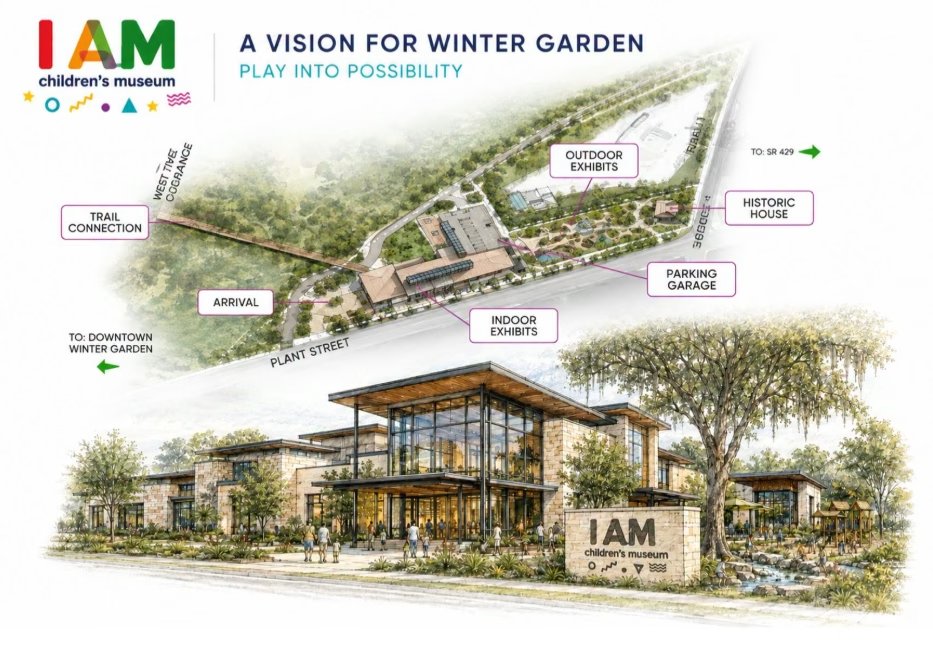
RENDERING FOR POROPOSED CHILDREN'S MUSEUM IN WINTER GARDEN VIA 8 WAVES FACEBOOK PAGE
Orange County commissioners voted unanimously Monday to accept the citizen task force’s list of 12 projects recommended for future Tourist Development Tax funding, but stopped short of actually awarding any money, instead directing county staff to work with the County Comptroller’s office on a funding analysis before dollar figures get attached to any project. I hate math too.
Mayor Jerry Demings reconvened the Tourist Development Tax Citizen Advisory Task Force this summer; a body of more than 40 residents representing county districts, municipalities, chambers of commerce, hospitality unions, and economic development groups, co-chaired by former Orange County Mayor Linda Chapin and Lift Orlando President Eddy Moratin. Applications had to request at least $20 million to qualify, and the task force spent more than 20 hours across public meetings in late July and early August reviewing 20 applicants, hearing from Georgia State University’s Center for State and Local Finance on the projected economic impact of each proposal, before voting on which to recommend. I’m not sure why it broke down in 20s.
The 12 recommended projects include a Dr. Phillips Center for the Performing Arts expansion with new parking and an outdoor amphitheater; a roughly $60 million Dr. Phillips Charities museum on the historic Hungerford Property in Eatonville; a $54 million Florida Citrus Sports parking garage and events center at Camping World Stadium; a training and conference center for the City of Ocoee; funding for the Eatonville Community Redevelopment Agency’s historic district; Orange County’s Eco-Tourism Grant Program and Arts and Cultural Affairs Program; support for Creative City Project’s Immerse Festival; a children’s museum from 8 Waves in Winter Garden; and a nature center for the Orange Audubon Society at Lake Apopka, and more.
Notably absent from the list: the Orlando Dreamers’ $975 million pitch for a professional baseball stadium and the Orange County Convention Center’s $523 million expansion proposal, both of which the task force declined to recommend.
Task force co-chair Linda Chapin was careful to frame Monday’s vote for what it was, saying, “You are being asked to accept the recommendations,” she told the council, distinguishing that procedural step from actually committing funds. Commissioner Nicole Wilson said she was encouraged by the range of proposals that came forward: “I was really excited to see the wide variety of uses that came forward.” Commissioner Kelly Martinez Semrad was more critical of the timeline, saying “the process unfortunately felt rushed.” Mayor Demings, for his part, was blunt about the arithmetic ahead: “We have money… and everybody wants some of it. Everybody isn’t going to get some of it.”
The Tourist Development Tax is a 6% levy on hotel rooms, Airbnbs, and other short-term lodging in Orange County, and it brought in a record $384.6 million in the 2025 fiscal year. But most of that revenue is already spoken for, with a large share going to Visit Orlando marketing contracts, debt service and operations on the Orange County Convention Center, and debt tied to the Dr. Phillips Center and area sports venues. The money actually available for new projects is a much smaller pool: county staff told commissioners there isn’t enough uncommitted funding to cover all 12 recommended projects while also holding the county’s reserve at its roughly $300 million target, a cushion officials consider necessary before they’ll commit new money long-term.
That’s why commissioners didn’t attach dollar figures Monday. Instead, the board asked staff to work with the Orange County Comptroller, the office that collects and accounts for TDT revenue, to model out what the county can actually afford: how much cash is on hand versus how much would require bonding against future tax collections, what that borrowing would cost, and how funding all or some of the 12 projects would affect the reserve cushion the county wants to protect. Only after that financial analysis comes back will staff bring commissioners a specific, project-by-project funding recommendation for an actual vote, the step where money gets awarded rather than merely endorsed. No date has been set yet for that follow-up vote, but it will determine which of the 12 recommended projects get funded and how much each receives. Why that didn’t happen during the task force review process has not been made clear.