




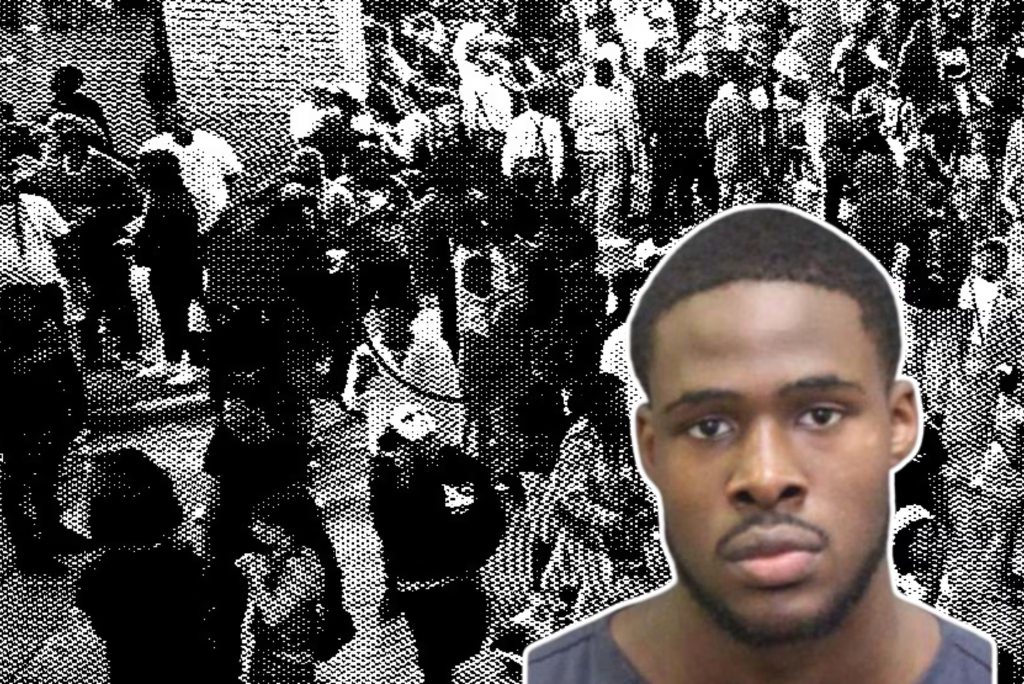
A jury found 18-year-old Jaylen Edgar guilty on all nine counts Monday for opening fire on a crowded downtown Orlando street during Halloween festivities in 2024, convicting him of killing two men and wounding seven others in an attack that briefly shut down the city’s entertainment district.
Circuit Judge Keith Carsten read the verdict after jurors deliberated for roughly three hours: guilty on two counts of first-degree murder and seven counts of attempted first-degree murder. “Mr. Edgar, a jury assembled from the community with your participation has found you to be guilty as charged in the indictment of nine counts,” Carsten told him.
The shooting took place in the early hours of November 1, 2024, as an estimated 75,000 people packed downtown Orlando’s bars and streets for Halloween. Edgar, then 17, had a brief, tense run-in with law enforcement and paramedics around 12:40 a.m., climbing into an ambulance and getting into an altercation with an officer. About 25 minutes later, at 1:07 a.m., he shot 25-year-old Tyrek Hill on Orange Avenue near Central Boulevard. Four minutes after that, at Orange Avenue and Washington Street, he opened fire into the packed crowd, firing roughly nine more rounds. An Orlando police officer tackled and arrested him near patrol vehicles moments later.
Hill was pronounced dead at the scene. Timothy Schmidt Jr., 19, was shot in the crowd and died later at the hospital. Seven other people were struck by gunfire and survived; at least one more bystander was injured after being trampled in the panic. Survivors who testified during the trial described lasting harm; Anthony Berry said he was shot in the head as he tried to push through the fleeing crowd, and Jonathan Valle testified that injuries to his head and foot left him with ongoing seizures and light sensitivity.
Orlando Mayor Buddy Dyer declared a local state of emergency in the shooting’s immediate aftermath, imposing a temporary 1 a.m. curfew downtown and banning midnight alcohol sales for about a week. Edgar was never actually admitted into a nightclub downtown.
Edgar was initially arrested on two counts of second-degree murder and six counts of attempted first-degree murder. By trial, prosecutors had secured an indictment upgrading the charges to the nine first-degree counts jurors ultimately ruled on. Because he was 17 at the time of the shooting, Edgar was never eligible for the death penalty, and he turned down a plea deal in favor of trial.
Assistant State Attorney Frank George told jurors in opening statements that Edgar’s actions were deliberate: “He went there to kill as many people as he possibly could.” Prosecutors leaned heavily on surveillance video and officers’ body-worn camera footage showing the shooting, the crowd scattering, and police running toward the gunfire. Footage that reportedly captured Hill’s death and drew visible reactions in the courtroom. The state’s final witness, Orlando Police homicide detective Joshua McNutt, played a recorded post-arrest interview in which Edgar told him he had lost 19 family members over his life and described downtown as “packed” that night, saying he tripped repeatedly moving through the crowd.
Edgar’s defense, led by attorney Junior Barrett, called no witnesses, declined to give an opening statement, and did not put Edgar on the stand. Barrett had floated a not-guilty-by-reason-of-insanity defense built on a letter Edgar wrote the judge claiming he acted under “extreme mental or emotional disturbance,” but ultimately conceded there wasn’t enough evidence to mount it. Instead, Barrett argued Edgar lacked specific intent to kill Schmidt or the seven wounded survivors, while conceding premeditation in Hill’s death. The judge rejected the argument before it reached the jury, ruling that firing into a densely packed crowd supports an inference of intent to kill everyone in the line of fire.
Sentencing is scheduled for October 20. Edgar faces up to life in prison, which is the maximum available, since his age at the time of the shooting rules out capital punishment regardless of the murder count. State Attorney Monique Worrell called the verdict “accountability for a horrific act of violence that turned a night meant for community, celebration, and joy into one of unimaginable loss.” Timothy Schmidt Sr., the father of one of the men killed, said he was relieved jurors rejected the defense’s argument on intent: “The defense played his cards the way he had them… I’m glad the jury didn’t see it that way. No one ever really understands the connection we had.” Edgar’s cousin, Martavious Reed, offered a different view outside court: “I think it’s wrong. I think he’s a good kid. He got a good future.”
The criminal case isn’t the only legal fallout from that night. In October 2025, the Haggard Law Firm filed a civil lawsuit on behalf of victims against the City of Orlando and Downtown Power, LLC, alleging criminal negligence tied to security conditions downtown. That case remains open and separate from Monday’s verdict. Edgar remains in custody awaiting his October sentencing hearing.