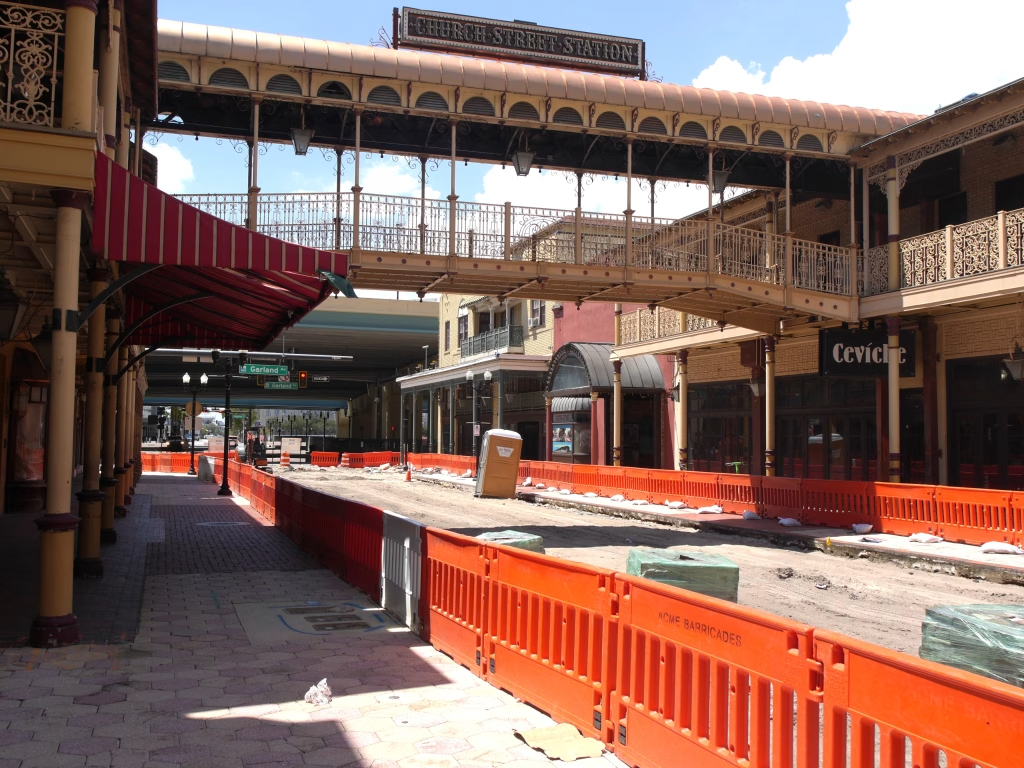
The Florida Department of State has notified Orlando Mayor Buddy Dyer that the city’s 36-month historic preservation moratorium violates the state’s Certified Local Government program, and has given the city 180 days to fix the violation or risk losing its certification and access to federal historic preservation grant funding.
In an August 21 letter, State Historic Preservation Officer Alissa Slade Lotane wrote that the city adopted Ordinance No. 2026-18 on June 22 without submitting it to the Division of Historical Resources for review at least 30 days before the scheduled adoption date, as required under the Florida Certified Local Government Guidelines. The department said it received a copy of the proposed ordinance from the city on June 12, just 10 days before the council’s vote.


According to the letter, after reviewing the adopted ordinance, the department determined it “does not comply with the requirements of the Certified Local Government (CLG) program and associated federal requirements” found in the National Park Service’s Historic Preservation Fund Grants Manual and federal regulation 36 CFR 61.6. Those rules require a certified local government’s historic preservation board to review alterations, relocations, demolitions, and new construction affecting locally designated properties. The moratorium instead moves downtown historic district projects to the city’s Appearance Review Board for the duration of the three-year pause, removing them from Historic Preservation Board review.
“Contrary to the requirements of the CLG program, the ordinance results in properties within one of the City’s designated historic preservation areas not being subject to review by the historic preservation board,” Lotane wrote.
The letter gives Orlando 180 days from August 21 to correct the violation. If the ordinance remains in effect as adopted after that window, the department said it will recommend to the Secretary of the Interior that Orlando be decertified from the Certified Local Government program.
Decertification would affect the city’s access to federal Historic Preservation Fund grants and eliminate its ability to waive matching-fund requirements under the state’s Small Matching Grant Program. The letter specifically notes that a pending grant award for a project called the “Supplemental Handbook for Property Owners in the City of Orlando Designated Historic Districts,” funded for the 2026-2027 state fiscal year, will be held in abeyance until the ordinance issue is resolved or the city provides documentation of matching funds.
Orlando has held Certified Local Government status since 1989, when the city, the state, and the National Park Service signed the original agreement designating Orlando’s participation in the program. Under that agreement, the city commits to enforcing local historic preservation legislation, maintaining a qualified review commission, and submitting proposed ordinance amendments to the state for review at least 30 days before adoption, in exchange for state technical assistance and access to a share of Florida’s annual federal preservation grant funding.
The city council approved the moratorium in a 4-2 vote on June 22, with Commissioners Chapin, Keen and Rose joining Dyer in support and Commissioners Patty Sheehan and Bakari Burns dissenting. Commissioner Ortiz (who is running for mayor) was noticeably absent. During that meeting, when commissioners asked about the city’s legal footing to move forward, Dyer and his team told them the city was within its legal rights to pass the ordinance, despite an earlier warning from the State, which was not shared with the commissioners ahead of the meeting, something Commissioner Sheehan shared when she made an impassioned appeal at City Council (11-minute mark) – see the letter for yourself below the video.
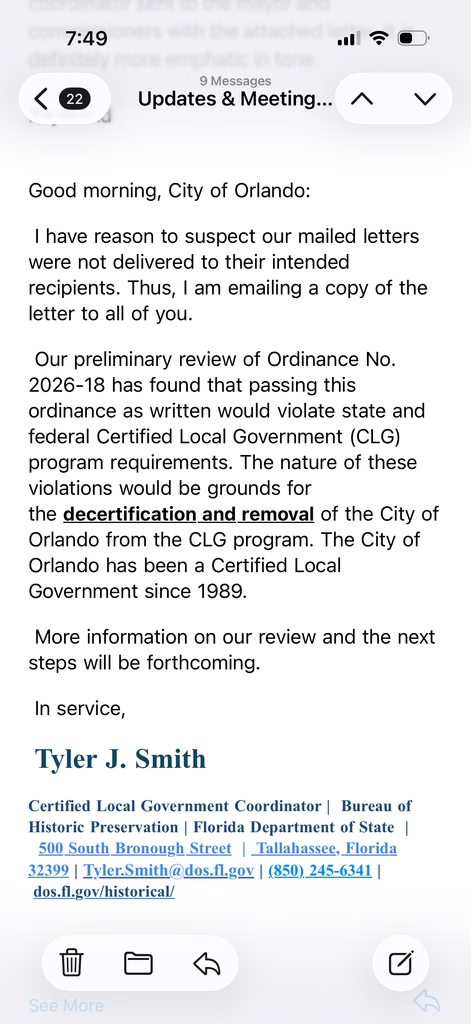
In response to the earlier warning letter, the Mayor’s team had the moratorium’s effective date pushed from immediate adoption to August, which the mayor’s office had described at the time as an effort to give the state the required 30 days’ notice. The state’s recent letter indicates that the adjustment did not resolve the underlying issue, since the required notice applies to the review period before the ordinance’s adoption, not simply its effective date.
Historic Preservation Board chair Jeff Thompson had warned city officials before the vote that the moratorium would “gut” the city’s oldest historic district, noting the board had not denied a single application from the downtown district in the past five years, and that the ordinance itself was counterproductive to the preservation of some of Orlando’s oldest buildings. He was also adamant that the move would result in a major hit to privately-led preservation efforts across Orlando, which he underscored in a recent conversation with Orlando Shine.
“The most significant impact from the loss of the CLG is the fact of who gets hurt. The majority of the grants have been to private organizations with limited means. With the loss of CLG status, they will no longer be likely to received grants due to the significant scoring advantage that comes from being in a CLG, and any future grants would be 50% matching grants only, and this could effective limit Grants coming into the City, especially for those with limited financial resources… The State also administers federal grant programs as well.
And this means that all of the City’s districts and landmarks will no longer be recognized by the state. CLG is a prestigious recognition for a city to have and shows a commitment and willingness to protect its architectural heritage…
The Mayor appeared unconcerned about the loss of these grants when the moratorium was discussed at City Council, which shows a lack of empathy for the small players regarding preservation and Orlando’s heritage in general. Equally concerning was how the City Attorney said at City Council that this moratorium would not effect the City’s CLG standing, even though the City and Commissioners were already in receipt of an email clearly stating it would result in the City’s loss of CLG status if the moratorium was approved. And even though the earlier letter was read to the Council at the meeting, the attorneys statement certainly provieded cover for the commissioners to support the moratorium. Now the City is in receipt of the final letter from the State saying the City will loose CLG status if the moratorium is not overturned within 6 months.”
– JEFF THOMPSON, CHAIR, HISTORIC PRESERVATION BOARD, CITY OF ORLANDO
Orlando Shine reached out to the mayor’s office for comment on the state’s letter and received the following response.
“In June 2026, City Council approved a temporary, 36-month modification to the review and approval process for projects in the Downtown Historic District. The ordinance is aimed at encouraging private sector investment and making it easier to renovate, reuse and invest in older downtown buildings.
As a courtesy, the city provided a copy of the proposed ordinance to the State’s Division of Historical Resources for review and comment. In response, the city received a letter from the State Historic Preservation Officer (SHPO).
The city is currently reviewing the comments and make any clarifications within the six-month response timeline.
The city remains committed to historic preservation and its status as a Certified Local Government to preserve and celebrate our community’s history.”
– MAYOR’S OFFICE, CITY OF ORLANDO