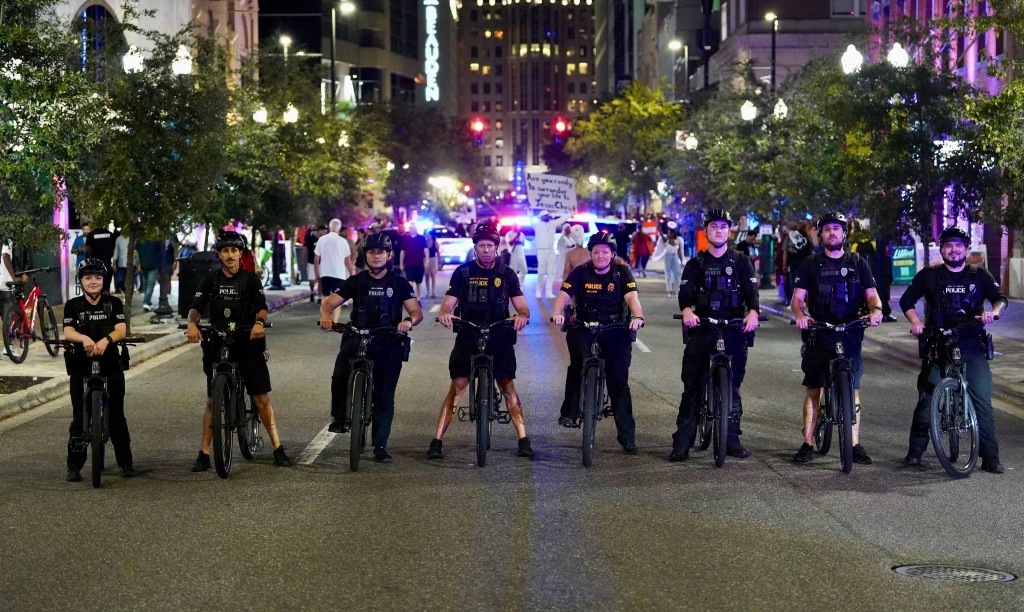
PHOTO VIA ORLANDO POLICE DEPARTMENT FACEBOOK PAGE
The National Independent Venue Association (Website) is calling on the City of Orlando to immediately suspend what it calls a “police-protection fee” on downtown bars and venues that serve alcohol after midnight, saying it has cost small businesses more than $4.3 million and contributed to 10 closures.
In a letter dated November 4 to Mayor Buddy Dyer and the Orlando City Council, NIVA Executive Director Stephen Parker asked the city to suspend the fee under the After-Midnight Alcohol Sales permit program pending a comprehensive review. NIVA, a national trade group for independent music venues, also released a statement on November 5.
The permit program, created under Ordinance 2023-17, requires businesses that want to serve alcohol from midnight to 2 a.m. in the Downtown Entertainment District to get a permit, use security measures such as metal detectors and ID scanners, and help pay for extra public safety resources.
According to NIVA, the city billed 39 downtown establishments a combined $4,304,461.60 for off-duty Orlando Police Department officers from June 2023 through August 2025. The group said 24 of those establishments were billed more than $100,000 each. The Beacham was billed $330,796.63, and Celine was billed $328,952.25. Weekly invoices range from $990 to $2,970 per establishment and are due whether or not the venue is busy, NIVA said.
Since February 1, 2026, the fees have been payable monthly in advance.
NIVA said ten of the 39 billed businesses have since closed: Ember, Shots, Chillers, Irish Shannon’s, Cahoots, High Tide, 1UP Orlando, HighT, Cocktails & Screams and The Attic. Together, they were billed $1,025,286.57 before closing, roughly one in every four dollars invoiced, according to the letter.
Orlando Shine has reported on some of the closures. The owners of Cocktails and Screams blamed “increasing fees and regulatory costs imposed by the City of Orlando” when they announced the closing in March. The Attic cited rising operating costs, increasing city fees and a “lack of meaningful support from local leadership” in May.
NIVA argues the fees fall on a small group of businesses while larger operations pay nothing. The letter says city-owned facilities such as Camping World Stadium, the Kia Center and Tinker Field are exempt, along with civic auditoriums, sports arenas, public lodging and movie theaters. It also says downtown hotel bars appear able to serve until 2 a.m. without a permit or fee. NIVA said Orlando is the only jurisdiction it found that places costs of this size on a defined group of small businesses, and compared the program with Kissimmee’s $250-a-year late-night permit.
“Police protection of public streets is a basic municipal service,” Parker said in the letter. Eric Fuller, owner of Celine (who will appear on this week’s episode of “The Orlando Shine Show” on Real Radio 104.1 FM), said in the release that the venue has paid the city more than $328,000 for officers who do not work inside its building, on top of nightly private security.
The letter makes four requests: suspend the fee immediately, convene a downtown public safety working group that includes independent venues and promoters within 30 days, adopt a funding model used elsewhere, and publish a full accounting of program spending and the properties exempt from it. NIVA also said litigation over the ordinance is pending before the U.S. Court of Appeals for the Eleventh Circuit, and that its request does not depend on the outcome.
A city spokesperson did not respond directly to the letter. “We need more time to review the NIVA letter to be able to provide a response,” the spokesperson said, instead sharing the city’s earlier statement on the permit program and recent violations.
The city said it has made significant investments in downtown and that maintaining a safe, welcoming downtown remains a top priority. It said its approach combines enforcement, security requirements, infrastructure improvements, and strategic investments. Measures include more code enforcement, funding for additional off-duty officers, controlled entry points during major events, lighting improvements, securing private parking lots, and stronger noise rules.
The city also pointed to its SAFE program, which provides grants to eligible businesses to offset security costs, including metal detectors, ID scanners, security wands and surveillance cameras. The city said these efforts have reduced overall downtown crime by 20 percent and violent crime by 4 percent since the same time last year.