



TY PENNINGTON PHOTO BY MICHAEL RUBENSTEIN PHOTOGRAPHY
Ty Pennington (Instagram | Website) has been a fixture in American home renovation television for more than two decades, from his role as carpenter on TLC’s Trading Spaces to becoming the Emmy Award-winning host of ABC’s Extreme Makeover: Home Edition, where his catchphrase “move that bus” became part of pop culture for a decade.
The designer, carpenter, and former model currently stars in HGTV’s Rock the Block and has built a career helping families transform their homes while making design accessible to viewers across the country. Now a Florida resident, Pennington took some time to answer 10 questions we had about his career, his current work, and his advocacy for bronchiectasis awareness (a chronic lung condition his mother lives with) ahead of the American Thoracic Society Congress coming to Orlando May 15-20.
Here’s what he said.
1) Ty, you’re currently starring in the new season of Rock the Block on HGTV. How does the show compare to your previous work, and what drew you to it?
Rock The Block is a great show with four design teams competing to basically design four identical houses. These are really great designers who have to bring their biggest creative ideas to compete with their peers. I’m super passionate about design, and the great news about the show is that I don’t have to do the work – I get to host! I love it because I think we’re all sort of armchair designers at home. The show has a little something for everybody, depending on how the teams design a different room each week. It allows us to all decide at home which design we like the best. Each team has a winner, but by the end of it, you could actually not win one particular room and still win the whole week, even the whole season, because it comes down to the estimated value at the end by the realtors. So, it’s a mix of design and what kind of upgrades you can make to your house to make it more valuable than somebody else on your cul-de-sac.
2) “Move that bus” was once one of the most iconic phrases in television. What was it like being at the center of Extreme Makeover: Home Edition during its peak? I used to watch it in Canada and had a huge crush on you.
First of all, thank you. I love Canada and the show. There’s a moment, that “move the bus” moment that was so magical. Not only because we had thousands of people from the community come out as far as you could see when you looked down the street, or how many people were there to welcome the family home. But that moment when the bus moved, and the family saw the house and saw the change in their life— that’s probably the greatest moment of change that I’ve ever experienced. To be able to witness that change in somebody’s face was a miracle. I’m not saying that what we did — building a house— was a miracle, but I think more importantly, we turned a page for somebody.
We all go through things in our lives that are very difficult, and what was great about Extreme Makeover: Home Edition is that we were able to turn that page. Sometimes people can’t do that themselves, and because of that, we were able to really dive into the family story. Extreme Makeover: Home Edition gave all of us hope that if everything goes wrong in our life, there are people who will come to our aid and be there for us in a time of crisis. That type of belief in our fellow neighbor is probably the best thing we could ever have. I think that Extreme Makeover: Home Edition will probably go down in history as the greatest feeling of a television show. It’s not a reality show where you hear people yell at each other all day. It’s the opposite, where you actually make things better in someone’s life.
3) What’s changed in the home renovation and design world since you started, and what’s stayed the same?
I think everything has changed. Designs not only change based on trends, but also technology changes. Who knew we would have the amount of choices in countertop materials, roofing and flooring materials, and lighting choices? Some of the shows that I started on, like Trading Spaces, we put tools in the hands of homeowners for the first time, and I think it sort of revolutionized everything about your home. Next thing you know, people are trying different things, and people’s view of how they live in their homes changed. Extreme Makeover: Home Edition brought to life the idea of not only living in a more design aesthetic home, but also a healthier home, as well as what is your dream home? Is a dream home a luxurious bathroom in your main suite? Or is it a luxurious kitchen that has the biggest island you’ve ever seen? I think everything has changed with design, and I love to see that. What I don’t like is when something stays the same, like beige and white, stays around forever. I love color, finishes, and brass. I love the fact that styles, just like fashion, change almost every four to five years.
4) Some of the “Extreme Makeover” homes are infamously … large. Do you think that if you were doing it today, it would focus on more sustainable footprints, or was half the fun watching how big y’all could make it?
I absolutely think we would build houses with more sustainable, eco-friendly footprints. We were on a television show, so I think in many ways, you not only want the room to seem big and loud and bold. Some of the things we did, I don’t think you would necessarily want to have in your own home. We did some crazy, fun stuff, but who wants a pirate ship as their pool backyard? That being said, I think we’d not only build a house, but we’d also build a community center. And the show seemed to get bigger, and bigger every episode. At some point we were like, is this even possible to build this much in a week? But that’s what it was— we were so blown away that we were able to do what we were doing. So, we thought, “let’s see if we can do even more.”
5) You’ve built hundreds of homes across the state, and could live anywhere, but built a little dream home of your own in Palm Coast in an old 1940s fishing cabin. What do you love about Florida life, and how did you keep that in mind when building your house?
I knew that it was an area I wanted to find property to build a house or renovate one. I walked down a road that turned into a driveway, and it was a heavily wooded tree canopy. It looked like a Mayan ruin. I did some digging and found out who they sold it to last. I ended up working with these people who build houses, and came up with a green LEED certified, eco-friendly idea. I wanted to use Florida materials that are indigenous. We did Cypress on the interior ceiling and the exterior, which means a lot of maintenance, but it’s really about that Florida living. I made it indoor/outdoor with a porch that you can open up to create a Lanai. I also put windows all the way around the house so that it was very light. I created an atrium to grow a grapefruit tree so you could pick fruit whenever you walked around the staircase. I thought about every single detail and also thought about where it was located.
6) You’re known for transforming homes. If you could give one Orlando landmark a design makeover, what would it be, and what would you do?
I love the history of Orlando. I would bring back some of that old world, like, you know, that section of Disney that’s still the original, like, that magic is never going to go away. And I think you could also bring that back in some of the downtown parts of Orlando.
7) Central Florida has a unique mix of old Florida ranch homes and new modern construction. Which style appeals to you more as a designer?
I definitely like the old ranch style, especially if you get the terraced metal roof — it’s actually like a copper or tin roof that’s almost pyramided. I like the Florida windows that crank down, which are basically little blinds. I love that old school look. In fact, that’s what was in the fishing cabin when I first found it, but I had to do everything over and had to build it to Miami-Dade hurricane code. I kept it looking like it’s a one-story on one side, but on the other side, it was actually a two-story. You have to be creative. You can still design it to look like it’s that old school, sort of mid-century ranch, but you really want the technology and materials that we’re using today, so that the house can sustain a big storm.
8) You’ve built a career helping families through home renovations. How does that experience translate to helping raise awareness about a medical condition?
In my world of home renovation, if something isn’t working, you don’t just paint over the problem – you look behind the walls, in the attic, and check the foundation, because what you can’t see matters. It’s important to look deeper and find an expert who can tell you what’s really going on. In this way, your health can be similar. If symptoms you’re experiencing keep coming back or don’t seem to improve, it may be worth taking a closer look, talking with a doctor, and asking more questions.
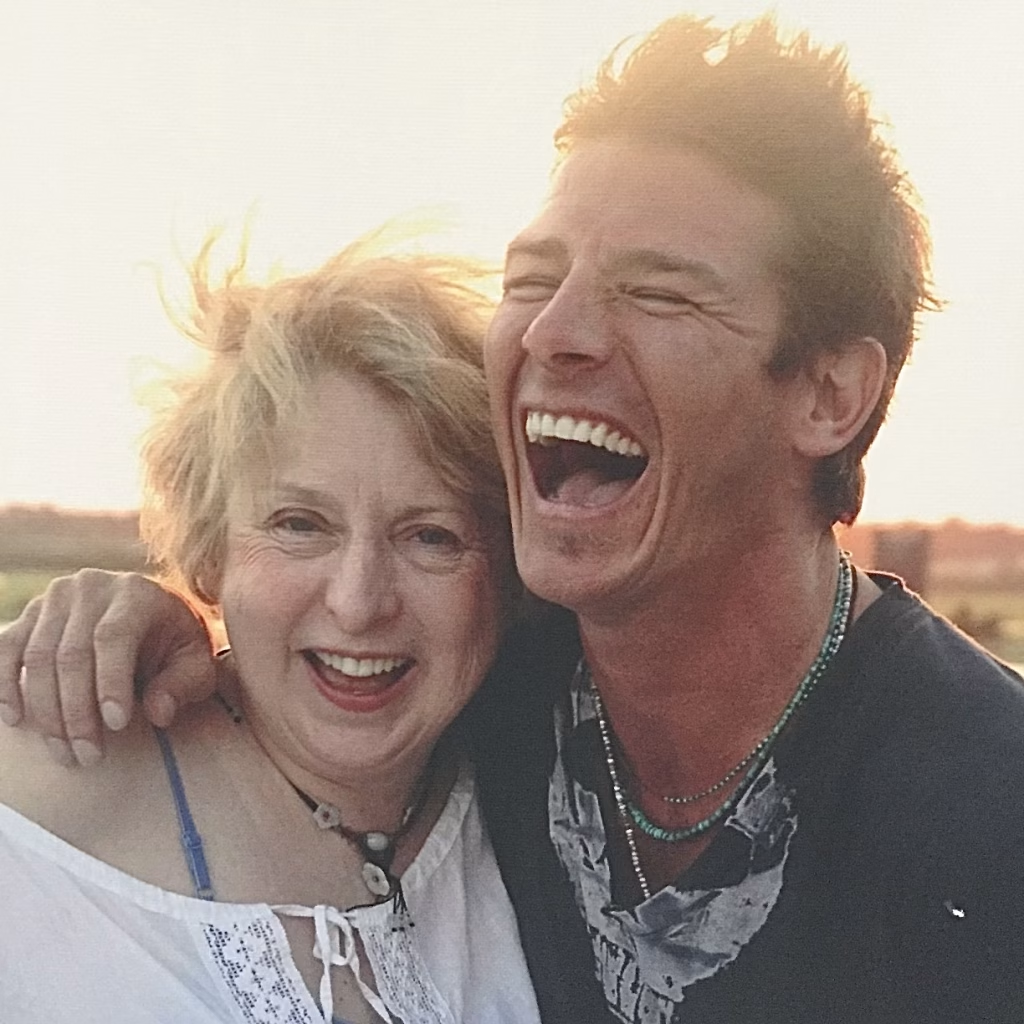
9) You’re working with Insmed on an educational initiative about bronchiectasis. Florida has been identified as a U.S. “hot spot” for the kinds of lung infections and environmental exposures associated with bronchiectasis. What should Floridians know about it?
I think it’s important for Floridians, and you know everyone across the country, for that matter, to know that bronchiectasis, or BE for short, is a chronic lung disease that can worsen over time and may also lead to lung damage. I’ve teamed up with Insmed as a spokesperson on Suspect BE after witnessing my mom live with bronchiectasis for nearly two decades. The goal of this initiative is to increase awareness and proper diagnosis of bronchiectasis.
What I’ve learned is that BE may present like other common lung conditions, like COPD or asthma, and in some cases, people may even have more than one lung condition at the same time, which can lead to delays in diagnosis. That’s why it’s important for people living with unresolved or recurring respiratory symptoms to look deeper and speak with a pulmonologist to see if additional testing, like a CT scan, is the right next step to rule out or confirm bronchiectasis. For more information, visit SuspectBE.com.
10) What’s next for you professionally, and are there other health or social causes you’re passionate about?
In addition to Rock the Block, Battle on the Beach is coming back, where I mentor a team to find the right creative path. I’m trying to give power to the people who want to be creative, but don’t have the confidence to really believe in themselves yet.
Growing up with ADHD, I know confidence is the one thing you may lack, but when you find someone who believes in you, it changes your life. I love mentoring people who are passionate about design but don’t have confidence yet.
I have several renovation projects going on, and I’d love to wrap those up, but do we ever finish our renovation projects? Not really. We just finish one aspect of it and start a new one. So yeah, I love being involved in so many different projects.