




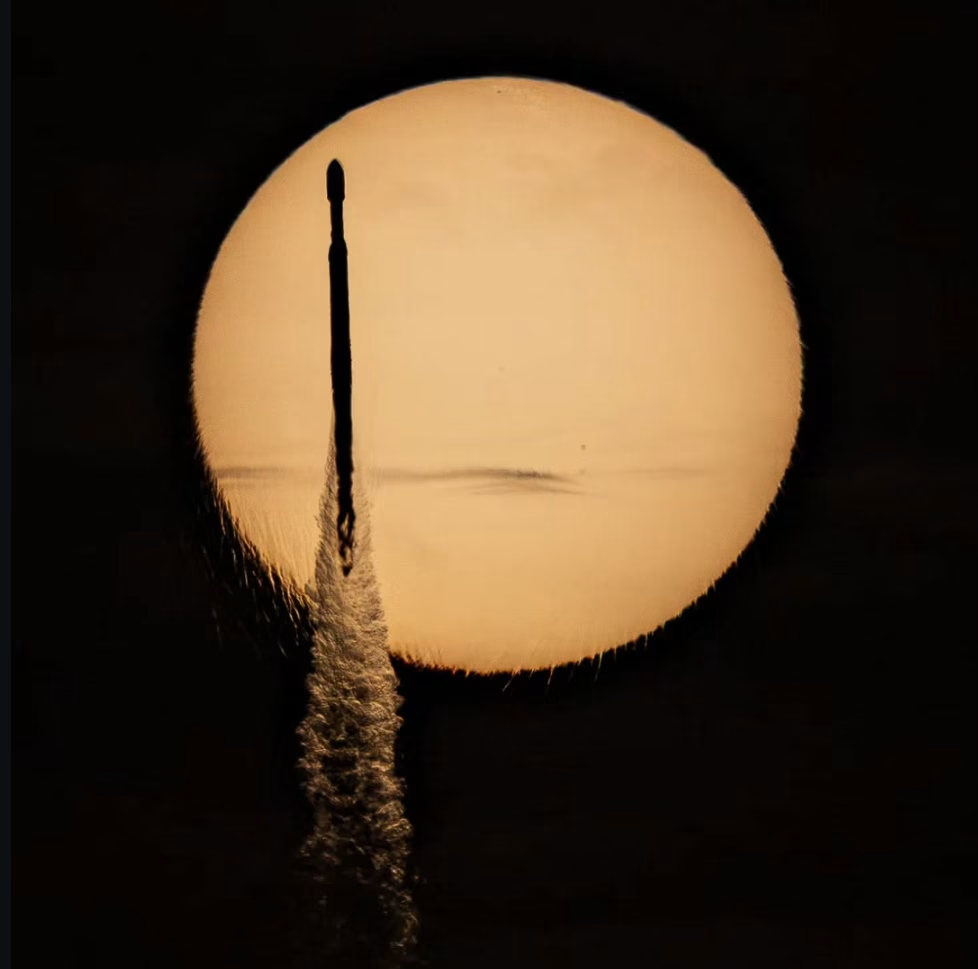
PHOTO BY PASCAL FOUQUET @PF.PHOTOGRAPHY
NASA’s newest space telescope launched Sunday from the Kennedy Space Center, beginning a mission to study dark matter, dark energy and thousands of planets beyond our solar system.
The Nancy Grace Roman Space Telescope, roughly the size of a tour bus, lifted off at 7:26 a.m. aboard SpaceX’s Falcon Heavy rocket. The 18,000-pound spacecraft is now on a three-month journey to its new home about a million miles from Earth, at the second Sun-Earth Lagrange point, known as L2, the same location that hosts the James Webb Space Telescope. The competing gravitational pulls of the Earth and Sun allow spacecraft parked there to maintain a steady orbit while using minimal fuel, giving Roman an unobstructed view of the sky. Science.
The telescope actually began as a spy satellite built for the National Reconnaissance Office before being donated to NASA. It’s named for Nancy Grace Roman, NASA’s first chief astronomer, known as the “Mother of Hubble” for championing that telescope decades earlier. Roman’s namesake observatory will match Hubble’s image-snapping abilities while offering a field of view at least 100 times larger, letting it capture huge swaths of the sky in a single image.
Roman’s core mission centers on dark matter, the invisible substance with a suspected gravitational pull that appears to hold galaxies together, and dark energy, the mysterious force believed to drive the universe’s expansion. The telescope will study how gravity subtly bends the path of light across vast distances, helping scientists map both normal and dark matter, while also cataloging exploding stars known as Type Ia supernovae to refine understanding of dark energy.
The telescope will also hunt for planets outside our solar system. Since exoplanets were first confirmed in the 1990s, astronomers have identified more than 6,000 of them. NASA expects Roman to identify more than 100,000 additional exoplanets by detecting dips in starlight as planets pass in front of their stars, along with roughly 1,000 more through a technique called microlensing, which detects tiny shifts in background starlight caused by a distant planet’s gravity. The spacecraft will also test technology capable of directly imaging exoplanets by blocking out their host star’s light.
Once operational, Roman will send back 1.4 terabytes of raw science data daily through a refrigerator-sized high-gain antenna, all of which will be made available to scientists and the public immediately through a cloud-based system called Roman Nexus. “Roman’s database at the end of its prime mission after five years is going to be bigger than your standard music streaming platform,” Perkins said.
Orlando Shine Photo Friend Pascal Fouquet (Instagram) managed to capture this story’s main image in Titusville this weekend during the launch, saying, “I’ve been dreaming of this shot ever since I captured a Falcon Heavy lunar transit back in 2023. It was great seeing all the amazing space photographers out there today!”