



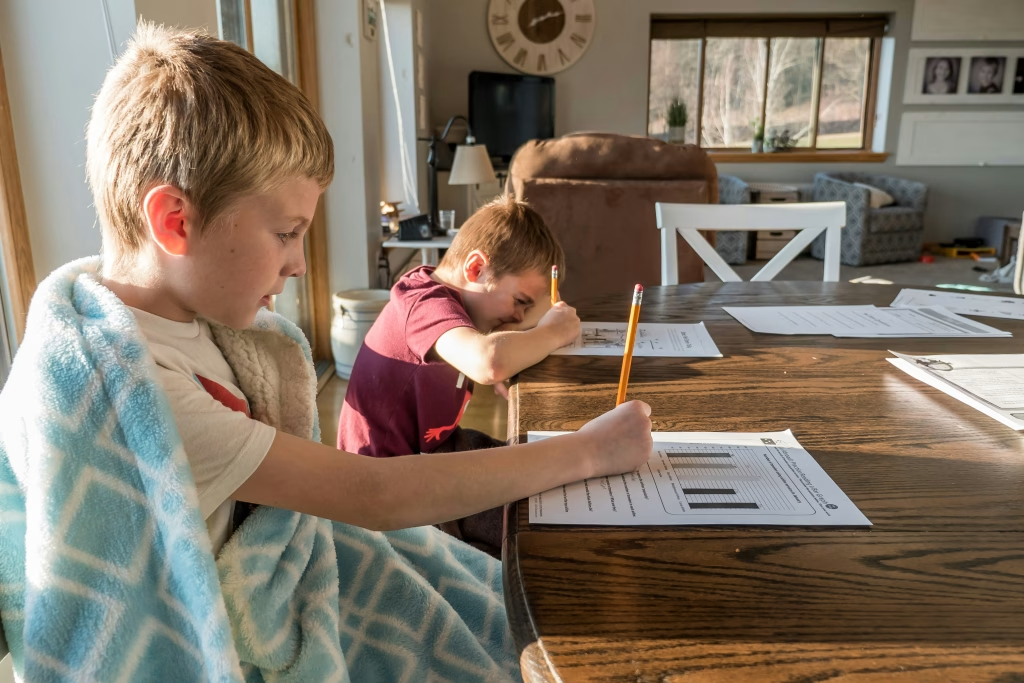
PHOTO BY JESSICA LEWIS VIA UNSPLASH.COM
Florida’s K–12 education landscape has undergone a seismic shift this summer. Traditional public schools are seeing significant declines in enrollment, and in their place, homeschooling, charter schools, and private institutions supported by state-funded vouchers are surging, fueled by sweeping legislative changes and shifting parental preferences.
Since the 2019–20 academic year, Florida’s public school system has lost an estimated 55,000 students. By the 2023–24 school year, more than half of the state’s 3.7 million K–12 students, estimated at approximately 1.8 million, were enrolled in alternatives to neighborhood public schools, including private, charter, homeschool, and magnet programs.
Large urban districts have borne the brunt of these losses. Miami-Dade, Broward, and Duval counties collectively lost over 53,000 students since 2019. A decline that has prompted district leaders to consider drastic measures, including redrawing attendance boundaries and closing under-enrolled campuses.
Simultaneously, non-traditional education options have grown rapidly. Private school enrollment in Florida increased by 47,000 students between 2019–20 and 2022–23, reaching approximately 445,000 students. Homeschooling saw a similar boom, with nearly 154,000 students opting out of institutional learning altogether: a jump of 50,000 over the same period.
Charter schools also benefited from the shift, adding about 68,000 new students during the same window of time. These options have gained traction among families seeking more tailored educational experiences and among advocates pushing for expanded parental choice.
Much of this transformation can be attributed to policy shifts that expanded access to school vouchers. In 2023, the Florida Legislature passed House Bill 1, which removed income eligibility limits for the Family Empowerment Scholarship program. This effectively opened vouchers to every student in the state, even those who were already enrolled in private schools or being homeschooled.
The impact on public school funding has been significant. For the 2024–25 fiscal year, Florida allocated an estimated $3.9 billion, nearly a quarter of its education budget, to private education vouchers. From 2019–20 to 2022–23, the percentage of Florida Education Finance Program (FEFP) funding redirected to private voucher programs tripled, from 3% to 10%.
This redirection of funds has left many public school districts struggling to adjust to mid-year budget shortfalls. Because voucher funding is deducted from state allocations after district budgets are set, school administrators are facing unexpected revenue gaps with limited flexibility to adapt.
Districts across the state are feeling the pinch. In Flagler County, for example, a projected enrollment drop of 432 students created a $2.5 million budget deficit, leading to staff cuts and curtailed programs. Fixed costs like building maintenance and staff salaries remain, even as per-student funding vanishes.
Moreover, some districts are facing new competition from within. Legislation passed in mid-2025 allows charter schools to co-locate within existing public school buildings, especially those with declining enrollment. This provision could accelerate public school closures and further destabilize district operations.
Questions of oversight have also surfaced. Private and homeschooling institutions that receive public funding through vouchers are not held to the same transparency, testing, or accountability standards as public schools, raising concerns about educational quality and equity.
According to a state education forecasting report released in April 2025, Florida’s public schools are projected to lose another 66,000 students over the next five years. Meanwhile, the number of voucher recipients is expected to increase by over 240,000, many of whom will continue to be private school or homeschool students already outside the public system.
Florida’s public education system stands at a crossroads. While school choice has expanded dramatically, it has also exposed the fragile fiscal structure that underpins public education. Unless districts find new ways to adapt or unless policymakers reconsider the long-term implications of unchecked voucher growth, the decline of traditional public schools may accelerate beyond the point of recovery.