

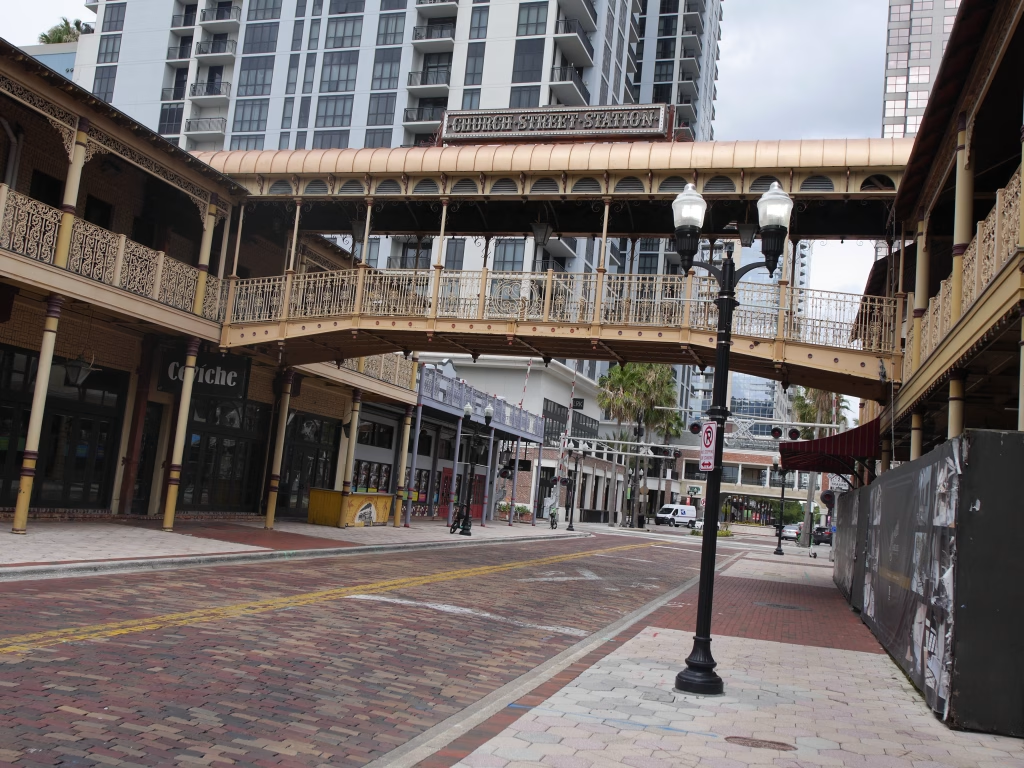
There’s been plenty of handwringing and mud-slinging online concerning the recent Festival Street-ification of downtown Orlando’s Church Street corridor, including a scathing video from talking head Patrick Carr (Instagram | YouTube), calling it an outright waste of taxpayers’ money.
So we looked into it, and asked for a breakdown of the costs so you don’t have to.
Newly obtained bid documents show Atlantic Civil Constructors Corp, an Apopka-based civil contractor, submitted a base bid of $4,015,082.16 to build Phase I of Church Street’s festival street redesign, the project the city has said is meant to make the corridor more walkable rather than recreate the “street party atmosphere” it cracked down on in 2021.
The bid opened April 23 and covers 135 line items between Garland Avenue and the SunRail tracks. The total is below the $5.2 million figure the city cited when it broke ground on the project in July, a gap that likely reflects the difference between the low construction bid and the full project budget, which typically includes design, contingency, and other soft costs that arise outside of the actual labor of building something.
The single largest line item is “mobilization,” at $543,053.58, the standard upfront cost of setting up a contractor’s crews, equipment, and staging for a job of this size. Maintenance of traffic, the lane closures, barricades, and signage required to keep the corridor safe during construction, adds another $278,632.37.
After that, the numbers get more interesting for a roadway project. A “media server” line item, with two units priced at $157,800 each, totals $315,600, the second-largest single cost on the entire bid. It’s paired with $70,000 for speakers, $68,400 for gobo lights, $107,680 for media converters, $59,440 for fiber extenders, and $52,370 for a DMX processor, the kind of equipment associated with stage lighting and event production rather than just regular street construction. Combined, that AV-adjacent equipment runs north of $675,000, more than a sixth of the entire base bid, and raises the question of how much of Church Street’s “not a street party” redesign is being built with street party infrastructure.
Underground electrical work adds up fast as well. Forty-three pull and splice boxes at $4,236 apiece total $182,148, and a line item simply labeled “aluminum, 30′,” with no further description, comes to $129,360 for eight units, or $16,170 each. It’s not clear from the bid tab alone what that item is, though the size and pricing suggest light poles, so we’re going with that. Mostly because we’re too busy to ask the Mayor’s Office for clarification.
Paving costs are led by nearly $282,000 combined for two types of decorative sidewalk pavers covering more than 12,000 SF, plus $73,680.98 for roadway brick (to replace the historic bricks that are being removed and kept somewhere offsite for a future project) and $73,183.50 for reinforced concrete sidewalk subslab. Landscaping includes $21,329.24 for two Sylvester palms, priced at more than $10,600 each, and $18,015.40 for five sky climber (live) oak trees.
A handful of unit prices stand out as unusually high compared to typical Florida road construction costs. Milling the existing asphalt pavement is priced at $138.96 per square yard, well above the roughly $3 to $8 per square yard that milling this shallow typically runs. Regular excavation comes in at $641.28 per cubic yard, and embankment fill at $980.87 per cubic yard. Those three items alone account for more than $186,000 combined, which hints at some other service being baked into the number.
Rounding out the bid are the more conventional costs of a downtown streetscape project: storm drainage and manholes, curb and gutter, irrigation and planting soil, ITS cabinets and cameras, benches, bike racks, waste receptacles and raised planters, none of which raise the same red flags on price.
The city has said Phase I is expected to be complete in late 2026 or early 2027, with Phases II and III targeted for 2028.