



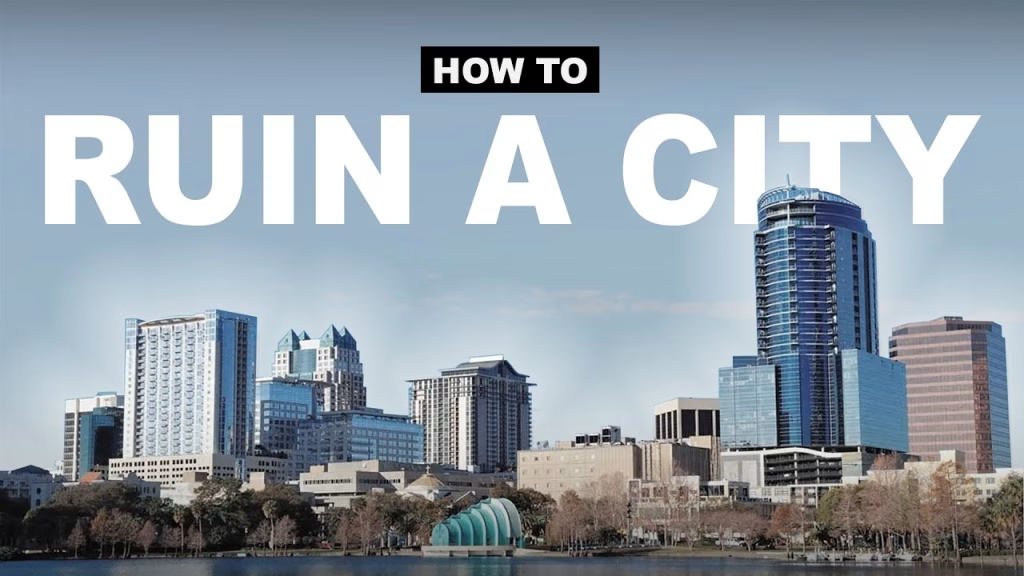
A YouTube video published last week by the channel Spaces Explained (YouTube) titled “Orlando: How To Ruin A City” has been making the rounds, and if you live here, it’s worth watching.
The video lays out four steps that, taken together, explain why a metro area of 3 million people can still feel like it was designed for someone passing through on vacation. It’s framed as a satirical how-to guide, but the argument underneath is serious urban planning criticism.
The first step in how to ruin a city, according to the video, is to build it around a corporation. The video traces the 1965 land grab in which Disney quietly purchased nearly 40 square miles of Florida swampland through a network of shell companies, then received from the state of Florida something almost no private company has ever gotten: its own government. The Reedy Creek Improvement District gave Disney the authority to build roads, levy taxes, and set its own building codes. The argument isn’t that Disney is villainous, but rather that the city responded by building around Disney rather than for the people who lived here, with infrastructure designed to move tourists, not residents.
Step two is the highway. I-4 is described as Orlando’s “one true organizing principle” with every major destination in the metro either sitting on it or reached by getting off it. The video’s sharpest observation is that a tourist family heading to Magic Kingdom, a nurse heading to her morning shift, and a construction worker heading to a job site all have to use the exact same road at the exact same time, with no alternative. There is only I-4. And I-4 cannot handle the load, and has never been able to handle it, and the response has always been to add more lanes, which the video correctly notes is “the infrastructure equivalent of loosening your belt and calling it a diet.”
Step three is making cars mandatory by design. Single-use zoning spreads everything apart. Sidewalks that exist for two blocks and stop. Six-lane roads with crosswalks every half mile. Apartment complexes surrounded by parking with no connection to anything adjacent. SunRail, the video notes, is a rail system that somehow manages to not connect to the airport, not connect to the theme parks, and stops running in the early evening — “a transit system that has looked at the places people need to go and the times people need to travel and decided, bravely, to serve neither.”
The final step is to keep going. More roads, more resorts, more sprawl into surrounding counties, more of the exact thing that was already not working. The video ends with the observation that Disney, which operates its own functioning transit system inside its own property, and which demonstrably knows how to build walkable, human-scaled environments, keeps expanding into a metro area whose infrastructure is already buckling.
The video is critical, but it focuses mainly on the choices that got us here and the fact that the people making those choices have generally not had to live with the consequences.
At the time of this post, the video had over 140,000 views.