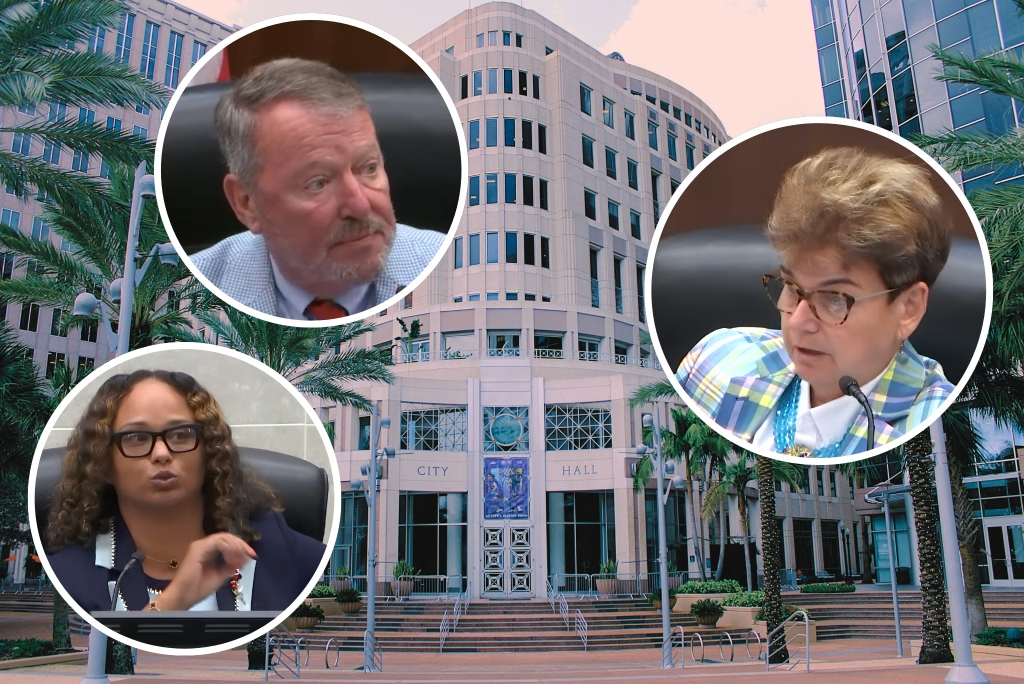




The City of Orlando held the first of two public hearings on its fiscal year 2027 budget Monday night, tentatively adopting a $1,881,067,697 total city budget alongside an unchanged general slush fund of $779,944,150.
Before opening the formal hearings, city staff presented an educational briefing on Florida’s proposed Amendment 3, which voters will decide in November and which city officials say could significantly affect future property tax revenue for local governments, including Orlando.
Budget and Financial Planning Director Jason Burrows walked commissioners through what the amendment would do. Under current law, homestead properties receive a $50,000 exemption from property taxes. If Amendment 3 passes, that exemption would rise to $150,000 in 2027 and $250,000 in 2028, while also lowering the assessment growth cap for non-homestead properties from 10 percent to 5 percent. The amendment also lays groundwork for a potential future elimination of homestead property taxes altogether, though it does not specify when or how that might happen.
Burrows said only about 35 cents of every property tax dollar collected in Orlando goes to the city itself, with the remainder split among the county, school district, library system, water management district and, in the downtown area, the Downtown Development Board. City property taxes fund police and fire protection, parks and recreation, infrastructure maintenance, and support for small businesses, nonprofits and community events.
Burrows said the city has kept its millage rate unchanged for more than a decade despite rising costs, citing examples like the cost of building a fire station more than doubling over the past 10 years and the cost of firefighter turnout gear also doubling over that span.
If Amendment 3 passes, Burrows said the city could see a roughly $30 million revenue reduction in its first year of implementation, growing to about $50 million the following year, and potentially as much as $80 million if homestead property taxes were eliminated, which would represent roughly 10 percent of the city’s total general fund revenue. Burrows said the amendment does not include any alternative revenue source to offset that loss, nor does it protect police and fire funding specifically.
Burrows said the likely effects of sustained revenue loss include slower growth in police and fire staffing relative to the city’s population, potential delays in road and infrastructure maintenance, reduced programming or hours at parks and neighborhood centers, and less funding support for arts, cultural and economic development organizations. He said the city could also need to consider new or higher fees, or a higher millage rate, both of which would fall more heavily on renters and non-homestead properties, including apartment complexes. Burrows noted more than 60 percent of Orlando residents are renters, who would not benefit directly from the amendment’s homestead exemption but could still see higher rents if landlords face increased costs.
Following the presentation, commissioners moved into the formal budget hearings. The city adopted a proposed millage rate of 6.6500 mills for fiscal year 2027, unchanged from the prior year, though 4.10 percent higher than the rolled-back rate of 6.3879. Commissioners also tentatively adopted the city’s overall budget, which increased slightly from the initial July proposal due to updated estimates, along with creating a new placemaking division within the executive offices – we told you about that HERE on August 11. The move will consolidate oversight of several city initiatives and public spaces, including Lake Eola Park, Luminary Green, the Downtown South Neighborhood Improvement District, Creative Village, the Public Art Program, See Art Orlando, the Downtown Clean Team and Ambassador Program, the future Canopy project, and the Pulse Memorial, under the oversight of Placemaking Director Sherry Gutch.
The Downtown Development Board’s proposed millage rate of 1.00 mill was also adopted, along with its $4,360,558 budget, unchanged from its July presentation. Commissioner Sheehan requested that future DDB budget materials include year-over-year comparison columns to make funding changes easier to track, particularly given recent funding cuts to historic preservation.
The Downtown South Neighborhood Improvement District’s proposed millage rate of 1.00 mill and $1,032,223 budget were also approved during a brief recess in which commissioners convened as the district’s board of directors.
No members of the public spoke during any portion of the hearing. A second and final public hearing on the millage rate and budget is scheduled before the new fiscal year begins on October 1.
You can watch the Budget Hearing on the City of Orlando YouTube channel.