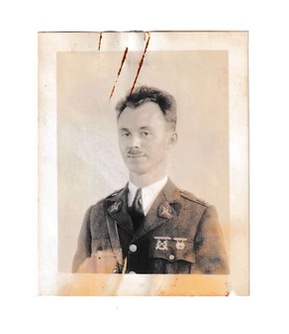


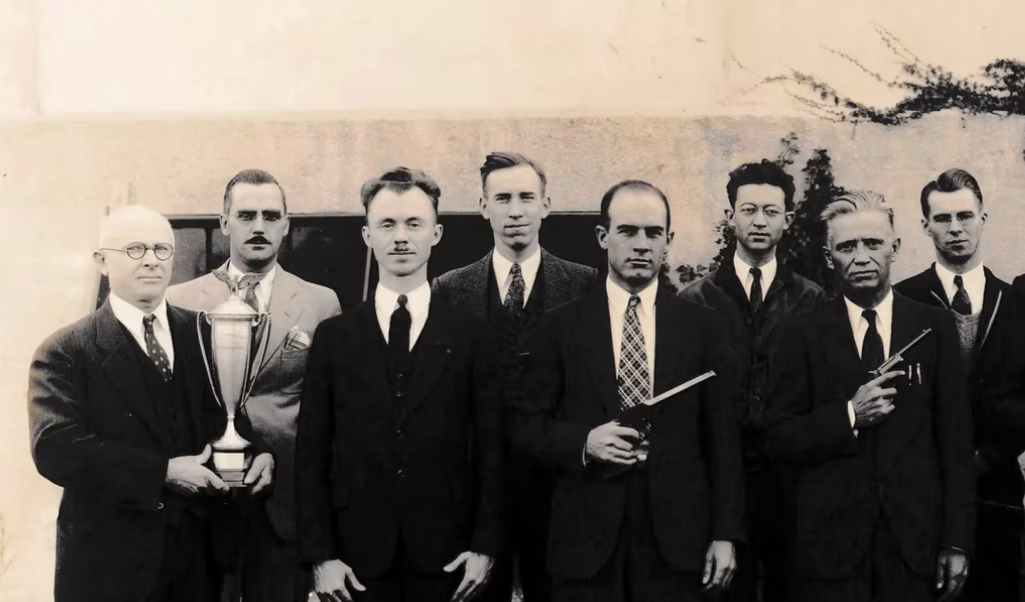
Colonel Claude S. Buchanan (third from the left) at an Award Ceremony
The following article comes to us from Elio Singer and a team of UCF Public History students who have spent the semester building the Claude S. Buchanan Digital Archive and Exhibit (Website), a new online collection featuring more than 100 digitized objects tied to Buchanan’s life and legacy. Colonel Claude S. Buchanan lived in Winter Park for more than four decades and served in a military career that included time at the historic Orlando Air Base, leaving a personal record that intersects with Central Florida’s broader history. The students’ work documents that story in depth, and we’re sharing their research and digital exhibit here as part of our ongoing effort to highlight local projects that preserve and interpret the region’s past.
During the Fall 2025 semester, three undergraduate students participating in the UCF Department of History’s Public History Central internship program learned what it takes to preserve a little-known local legend’s past just in time for the arrival of Veterans’ Month in November, by creating a special digital exhibit focused on the legacy of Winter Park resident, Colonel Claude S. Buchanan.
Buchanan (1890-1982) originally hailed from Grand Rapids, Michigan. In 1917, Colonel Buchanan was loaned out as a civilian worker by the Dodge Motor Car Company to the Aviation Section of the Army Signal Corps. There, he was responsible for contributing to the design of the Liberty L-12 engine, which powered an entire generation of American biplanes during World War I. Additionally, Colonel Buchanan designed the gunsight of the De Havilland Airco DH.9 biplane bomber. Interestingly, Colonel Buchanan did not officially enlist in the military until the mid-1920s. Through the winding path of his military service, he settled down in Winter Park with his wife, Ruth, and their daughter. In early 1949, Colonel Buchanan was transferred to the historic Orlando Army Air Force Base, which was deactivated in October of the same year. After officially retiring from the military in the 1950s, Colonel Buchanan remained in his Winter Park home until his death in 1982.
Mission Memory was founded by Sarah Miller Boye, a graduate student in the Department of History and Colonel Buchanan’s great-granddaughter. Having grown up in the same house Colonel Buchanan had built for her grandmother, Sarah’s academic path was certainly rooted in the abundance of historical artifacts and documented information from her own family history. Eager to share her great-grandfather’s storied history and collection of personal artifacts, Boye entrusted Colonel Buchanan’s legacy to Elio Singer, team lead of Mission Memory, and his two students, Aiyana Gross and Dianelys Nunez.
Singer has worked in museums and archives since the age of 14, applying his applied skills to his academic career in history and museum anthropology. He currently serves as an undergraduate researcher in collaboration with the Apopka Historical Board, researching Michael Gladden Jr., the city’s foremost Black businessman and humanitarian. His previous experience in web design and his passion for digital preservation directly inspired him to curate, design, and publish the Mission Memory Digital Exhibit and Archive. The student project features over 100 digitized objects and their individual histories, in a layout that was inspired by the look and feel of a well-loved scrapbook.
Visitors of the Mission Memory Digital Exhibit and Archive can access seven diverse object collections, including:
- The Claude S. Buchanan Photographic Collection features photographs following Colonel Buchanan’s military service and family life throughout the years.
- The Postcard Collection features bygone sights such as the original Albertson Public Library, The Cypress Methuselah, and the historic Joyland waterpark on Lake Ivanhoe.
- The McCook Field Photographic Collection has snapshots of the experimental airfield during the height of World War I, with a rare glimpse at the De Havilland DH.9 biplane.
- The Blueprint Collection features an original blueprint for the Liberty L-12 engine, which Colonel Buchanan contributed to the design.
For those interested in exploring the life of Colonel Claude S. Buchanan further, the Mission Memory Digital Exhibit and Archive is available to browse HERE.