

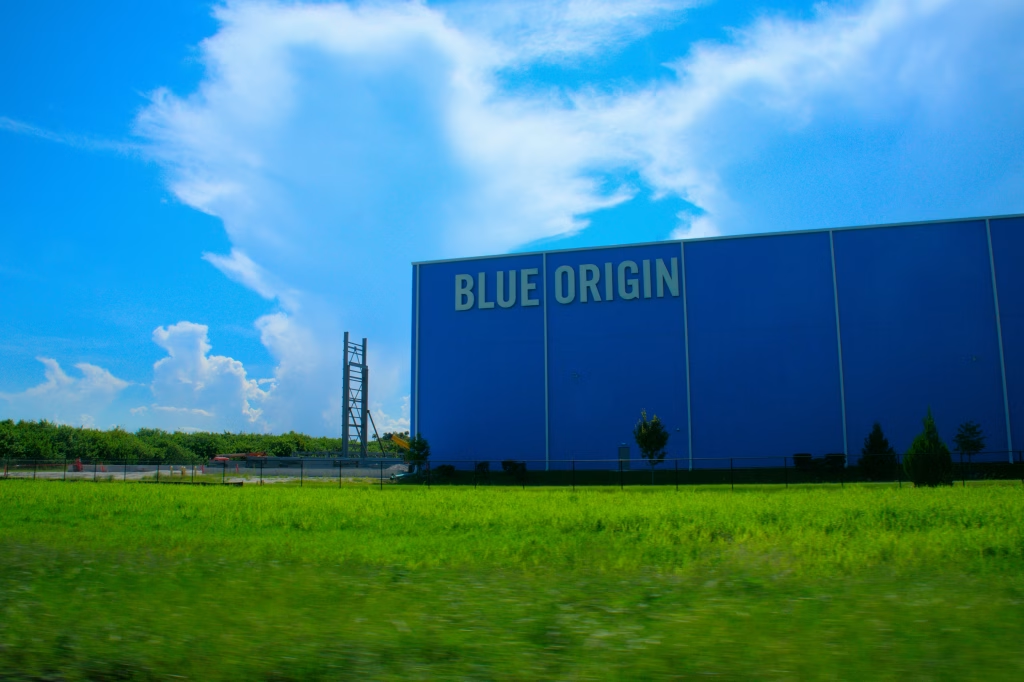
BLUE ORIGIN CAPE CANAVERAL FLORIDA PHOTO BY ELLIENORE B. VIA UNSPLASH.COM
While state and local officials are pouring hundreds of millions of dollars into restoring the Indian River Lagoon, a new draft permit sought by Jeff Bezos’s Blue Origin (Website) in Brevard County has raised alarm among scientists, environmental groups, and residents who say the effort to save the estuary is being undercut by decisions that continue to allow more industrial pollution.
Blue Origin is seeking approval from the Florida Department of Environmental Protection to discharge nearly half a million (490,000) gallons of treated industrial wastewater per day from its Merritt Island facility into a stormwater system that eventually flows into the Indian River Lagoon. Even though the company describes the proposal as a continuation of an existing permit they’ve held for five years, environmental advocates argue the lagoon is in no condition to absorb additional nutrient or chemical loads.
After decades of pollution, nutrient overloads, algal blooms, seagrass die-offs, and repeated fish kills, the estuary is widely considered one of the most environmentally distressed waterways in Florida. Manatees, dolphins, sea turtles, and native fish species all depend on seagrass beds and clear, oxygen-rich water, and these habitats have been collapsing for years.
At the same time, state and local governments have launched some of the most expensive and ambitious restoration efforts in Florida history. Brevard County’s voter-approved half-cent sales tax, known as the Save Our Indian River Lagoon Program (Website), launched in 2016 and is expected to generate roughly $586 million over a 10-year span, funding septic-to-sewer conversions, stormwater improvements, muck removal, and habitat restoration. State government has layered on additional investments as well, adding around $390 million in recent years, including a $100 million grant package announced this year to accelerate water-quality recovery projects across the lagoon’s watershed.
The goal of those initiatives is to reduce nutrient loading, rebuild seagrass beds, improve filtration, and stabilize a system that is dangerously close to long-term collapse. Critics say allowing more industrial discharge, treated or not, works directly against that investment. Even small increases in nitrogen, phosphorus, or chemical byproducts can intensify algae blooms, choke out sunlight, and further degrade water quality, especially in an estuary already operating on the edge and where people are handplanting blades of seagrass day by day.
For scientists who study the lagoon, the contradiction is stark: Florida is paying enormous sums to heal the Indian River Lagoon while simultaneously considering permits that risk reversing the progress those programs are trying to make. The lagoon’s recovery depends on reducing pollution from every possible source. Adding hundreds of thousands of gallons of industrial discharge per day could (and will) make that job significantly harder.
The Brevard County Commission and residents are calling on the FLDEP to host a public hearing before it issues a permit, though they have no real jurisdiction to stop it from happening, with the power resting in the state’s hands.
According to Florida Today, Blue Origin officials have shared a brief statement saying, “This is a renewal of an existing agreement that has been in place for more than five years. We are committed to maintaining responsible and compliant operations.” In that same report, they shared that Blue Origin had failed three environmental inspections in August.
“In an Aug. 28 draft consent order, DEP listed three violations for exceeding pH minimums, as well as sampling and inspection failures. That draft order proposed $22,950 in civil penalties plus $500 in costs, totaling $23,450. But by November, DEP’s offer had dropped to $5,450 in penalties, and the pH violations were no longer mentioned.”
– RICK NEALE AND JIM WAYMER, FLORIDA TODAY
Wastewater from Blue Origin and facilities like it can contain compounds like forever chemicals (PFAS, such as PFOA and PFOS), chemicals from industrial processes, and cleaning and cooling tower chemicals.