

PHOTO VIA WARRIOR GAMES
The 2027 Warrior Games (Website) are returning to the ESPN Wide World of Sports Complex for the third time on August 7–14, 2027. The Warrior Games bring together wounded, ill, and injured military personnel and veterans competing in several sports, while representing all branches of the U.S. Armed Forces, including the Army, Marine Corps, Navy/Coast Guard, Air Force/Space Force, and Special Operations Command. All sporting events are free and open to the public, with no ticket required for entry.
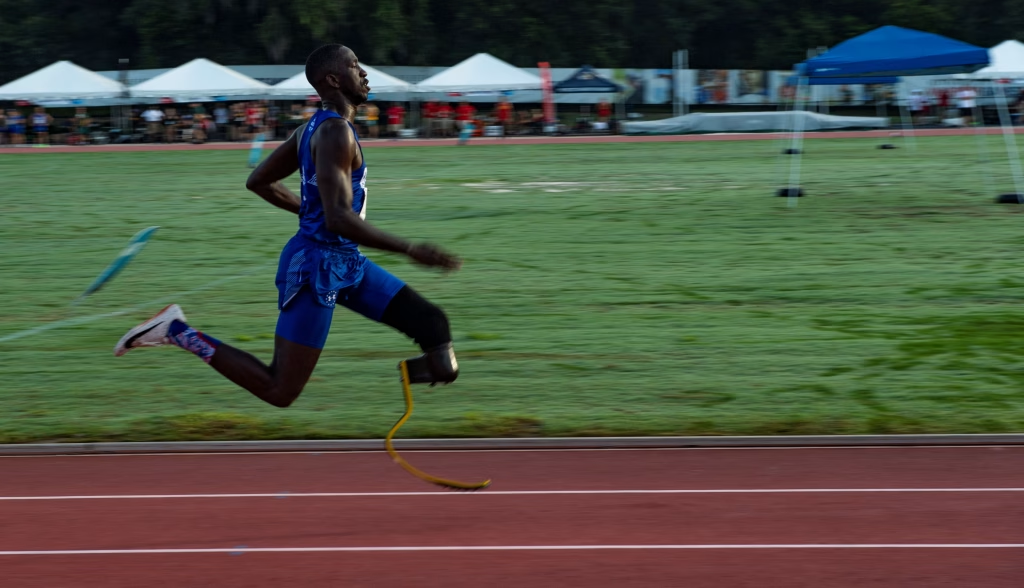
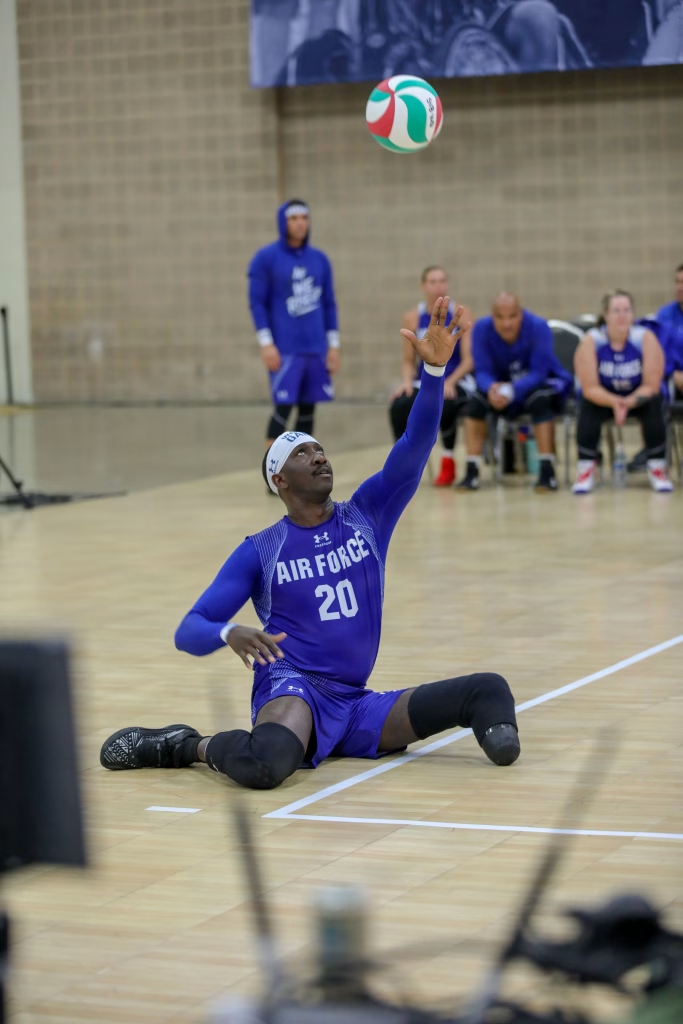
Master Sergeant Kevin Greene has competed for Team Air Force at the DoD Warrior Games three times, most recently representing the branch in adaptive sports including wheelchair basketball, cycling, track, field, indoor rowing, volleyball and wheelchair rugby. Greene, who lost his leg after a 2014 injury, became the first amputee reserve airman to return to active service. He spoke with Orlando Shine from Travis Air Force Base in Fairfield, California, where he now lives after moving from the Orlando area.
- How do you personally define resilience after everything you’ve been through?
I define resilience as the ability to bounce back from any setback. I think my first real taste of that was in eighth grade, right after I moved to Florida. I tried out for my middle school basketball team and didn’t make the cut. I didn’t know what resiliency meant at the time, but not making that team gave me the strength to keep going. It gave me some sort of passion, fuel, determination, and willpower. I think resiliency is an accomplice of all of that. It really gets truly defined after a setback.
2. What do you think it took, practically and mentally, to become the first amputee reserve airman to return to service?
It took every ounce of self-belief and faith. What drove me the most was hearing from my own command that I wasn’t fit for duty. That really pushed me. I had to look in the mirror and fight for my own self-worth. I knew I was fit for duty, so I refused to settle based on someone else’s opinion, someone who wasn’t even the one making the medical call in the first place. I just wanted to prove them wrong. That comes down to my own faith and self-belief, but it also comes from wanting to continue to serve.
3. Do you think those conversations spark something in other people when they see you continuing to serve?
For sure. A lot of the conversations I have are like, “Dude, how are you even insured?” Reservists and active duty are two different worlds, different benefit packages entirely. People ask me why I keep going if it’s not even guaranteed long-term. I want to show other reservists, other citizen airmen, that this is your career if you want it to be. Don’t let your physical or mental limitations, or something invisible, stop you from doing what you want to do, especially if you want to give back to your community. I just like serving my country.
4. You’ve spoken about how faith guided you through this. Can you tell me more about that?
My grandmother grounded me in my faith. She was the pillar of my belief in God and my sense of spirituality, and that played a major role for me, especially in the unknown. When you go through surgeries or first get injured, you just don’t know what’s next. For me personally, after repeated infections, after they kept cutting my limb, after the medications and being unemployed, I had to lean on something. If I kept listening to every voice and every opinion around me, it would’ve sent me down a rabbit hole into some sense of darkness. I leaned on prayer for guidance, strength, and peace of mind. I still lean on it to this day. I still have pain to this day, and I still have to perform like an able-bodied member of the service, running, jumping, push-ups, sit-ups, all of it. Nothing changes just because I have one leg instead of two.
5. How did you first get connected to the Air Force Wounded Warrior program, and what was your initial reaction?
It was 2018, but the introduction actually came a year earlier. The 21st Chief of Staff, General David Goffin, re-enlisted me in 2017, and during that re-enlistment he told me about the program. I didn’t even know it existed for the Air Force Reserve Command. His staff got me in touch with the program, and a year later I made it to my first event. Walking in, I felt so much love and compassion. Everybody was hugging, smiling, having a good time. They knew my name right off the plane. It was overwhelming. But I also felt isolated at first. A lot of the members there were combat wounded, and I wasn’t. I didn’t feel like I deserved to be there since I’d already been hurt years earlier, back in 2014, and was just now figuring things out in 2018. But they helped me realize I needed them more than they needed me.
6. What was it like walking into adaptive sports for the first time? Did anything surprise you? Do you like the term or should we just say “sports?”
Honestly, I’d call it inclusive sports more than adaptive sports. It gives everybody the opportunity to play. But yes, it surprised me. It gave me a newfound appreciation for people who were born with a disability and still want to be active, still want to go outside and do things. You don’t think about that community until something happens to you. I was naive to it. Seeing how people adjusted, how form-fitting everything was so that anybody could play, that inclusivity meant a lot to me, especially since I felt so isolated as, from what I understand, the only reserve amputee. Even something like hotel lodging is built for a normal member. In this community, it’s the opposite. They adjust to you.
7. Do you think the treatment of service members like you is changing in the military as a whole?
I don’t think the standard changes, and I don’t think it should. We’re still expected to meet the same standard, and that’s just the standard. But they’re not isolating us anymore, and they’re not putting an amputee in front of a unit and saying, “If this one-footed guy can pass the PT test, you can too.” They’ve stopped doing that, which is amazing, because that was never the goal. The goal is to work as a team, complete the mission, and put the best people out there who can get it done.
8. What sports do you currently compete in?
At the games, I’ve done cycling, track, field events like shot put and discus, and indoor rowing. But I really love the team sports: basketball, volleyball, rugby. Those are my jams. I gravitate toward the cardio stuff because it keeps me fit for continuing to serve. I’m not really a wheelchair rugby guy myself, though. I’m a finesse player. I run away from contact. But those guys who play it, a group of guys with PTSD in a rugby chair- it gets wild out there, and it’s a great outlet for them. I just don’t want to be the one getting hit.
9. How does competing at the Warrior Games compare to other competitions you’ve been part of?
The biggest difference is that Warrior Games brings families together. When you serve, you sacrifice a lot of time away from your family. The games give you that time back. Your kids get to see you smiling again after watching you go through something terrible and try to recover. We’re a bunch of adults with military trauma coming together to play games, and our families get to be part of it without worrying about parking or tickets or any of the stress that comes with other competitions. They get supported too: massages, resiliency programming, art. I haven’t been to another competition that cares about the families as much as it cares about the service members. That’s why I’ll keep coming back and volunteering however I can.
10. What’s next for you?
For the past three years, I’ve been coaching girls’ high school basketball in Brevard County, at Bayside High School and Heritage High School. Our girls made it to the state championship last season. That’s what I was doing before I moved out to Travis. What’s next now is figuring out how I can get back involved with the games, mentoring, volunteering, maybe joining one of the service branch staffs. Seeing former athletes come back and give younger service members the benefit of their experience is one of the most powerful things about this program. I’d love to be part of that. Or, honestly, I wouldn’t mind competing in one more game. There’s a Marine athlete, Pierre Sturgis, who I used to play wheelchair basketball with in Orlando. We always talked about competing together at Invictus someday. That’s still a dream of mine. But I figure the first step is saying it out loud.